The Fake 49er: What a $1.3 Million Romance Fraud Case Reveals About Manufactured Trust
By LegalVault Pro Team · 2026-09-02
On August 24, 2026, federal agents arrested two people in Boise, Idaho. According to a criminal complaint filed by the U.S. Attorney's Office for the District of Oregon, Daejon Labrayae Love, 35, and Taylor Jamie Chan, 18, ran a scheme that took roughly $1.3 million from at least 26 women across Oregon, Washington, Idaho, and California. Both are charged with wire fraud and conspiracy to commit wire fraud. The FBI has said it believes there may be additional victims who have not yet come forward.
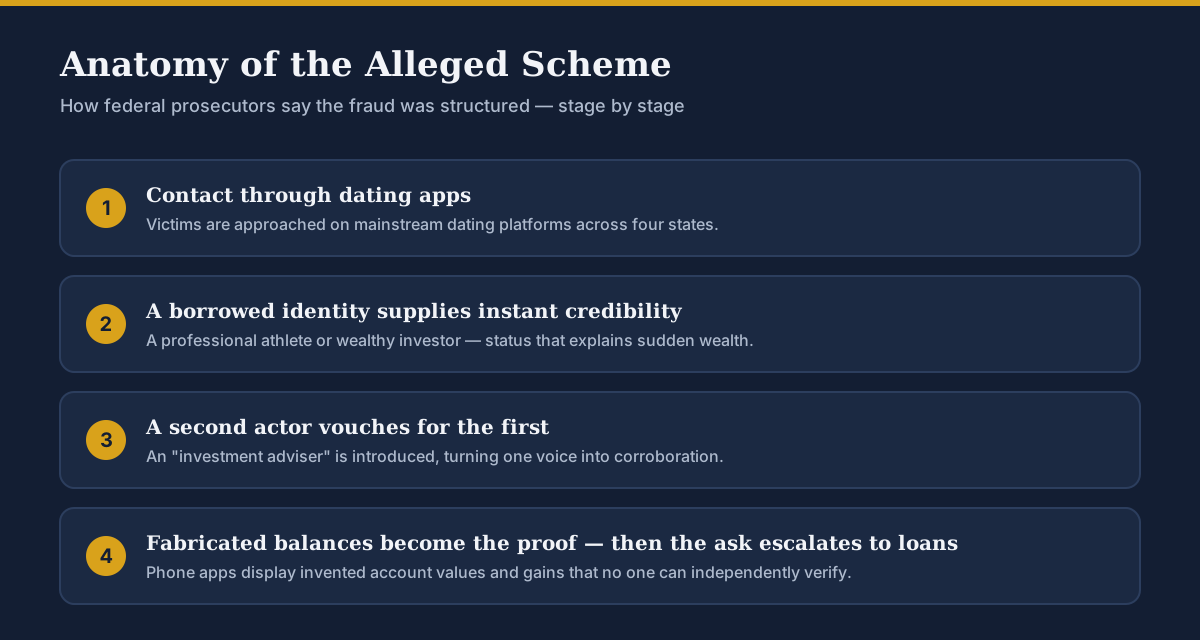
The detail that carried the story into national headlines was the costume: prosecutors allege Love told women he played for the San Francisco 49ers. When that story did not fit, they say, he offered a second one — that he was a successful real estate investor.
An important note before going further. Everything described here is an allegation contained in a charging document. Love and Chan have been charged, not convicted, and both are entitled to the presumption of innocence and to contest this evidence at trial. Nothing below should be read as a finding that either committed a crime. What makes the case instructive is not the guilt of any particular defendant — it is the structure of the scheme prosecutors have described, which is neither novel nor unusual.
The Athlete Was the Least Important Part
It is tempting to file this under celebrity impersonation. That misses what prosecutors actually describe.
The claim of an NFL career was not the fraud. It was a shortcut to something harder to obtain: an explanation for sudden, unexplained wealth that also discourages scrutiny. A professional athlete is publicly wealthy by definition. Asking one to document his finances feels insulting rather than sensible. The same is true of the backup story — a real estate investor occupies the same social position, wealthy in a way that is difficult to audit from the outside.
This is affinity fraud's central move. The persona is chosen to make verification feel socially costly. Once a victim believes that asking for proof would damage the relationship, the fraud no longer needs to defeat scrutiny. It has persuaded the victim not to apply any.
Which is why the second person in this case matters more than the jersey.
Two Voices Are Not Two Sources
The complaint alleges that Love introduced Chan to victims as his investment adviser. That is the structural heart of the scheme, and it is the part most likely to appear in the next case.
Corroboration is how ordinary people check extraordinary claims. We rarely audit documents; we ask whether anyone else confirms the story. A scheme with a single participant fails that test immediately. A scheme with two participants passes it — falsely, but convincingly — because the victim is no longer hearing one man's account of his own wealth. She is hearing a professional confirm it.
The independence is the illusion. Both voices originate from the same source. Prosecutors say Chan flew from California to Idaho to meet Love, which is where both were arrested — the coordination was the enterprise.
For anyone assessing a financial claim, the practical question is not *has someone else confirmed this?* It is *did the confirmation reach me through a channel the subject does not control?* An adviser introduced by the person he vouches for supplies no independent confirmation at all. Neither does a website, a business card, or a phone number that arrived from the same hand.
Proof That Only Exists as a Picture
Prosecutors allege that the pair used phone applications to display fabricated bank and investment accounts, showing balances and gains that did not exist, and that they conducted video calls in which victims were shown these falsified returns in real time.
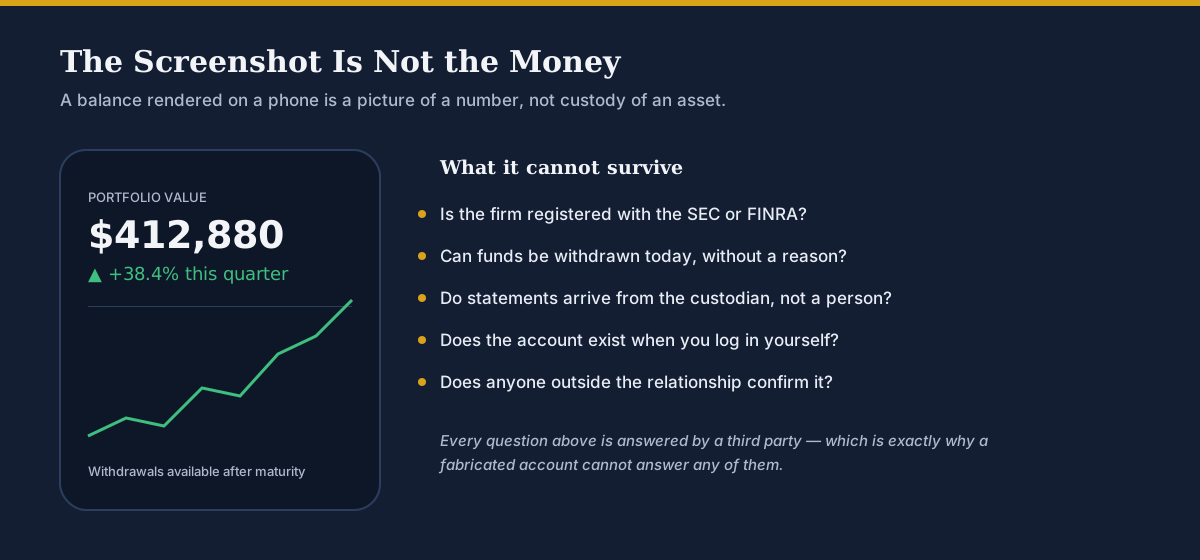
The economics here are worth stating plainly. Producing a screen that displays $412,880 costs essentially nothing. Producing $412,880 is hard. A screenshot, a dashboard, and a video call of a dashboard are all the same artifact: a rendering controlled entirely by the person who wants you to believe it.
The scheme allegedly ran from February 2022 to August 2026 — more than four years. Long-running frauds of this shape usually survive because the displayed balance keeps growing. Rising numbers feel like evidence of success, and they make withdrawal feel irrational. Why pull money out of something performing this well? By the time a victim does try to withdraw, the fabricated gains have become the reason the money cannot be released: taxes, fees, maturity periods, penalties. Each obstacle is presented as a consequence of good returns.
A real custodial account can be checked independently. You can log in through a channel you found yourself, request a withdrawal without offering a reason, and receive statements from an institution rather than a person. A fabricated one fails all three tests instantly — which is why the tests are worth running before money moves, not after.
The Escalation Into Debt
The most damaging allegation in the complaint is also the quietest: victims were pressured not only to send savings but to take out loans.
This is the point at which a fraud stops being a loss and becomes a durable financial injury. Money sent from savings is gone. Money sent from a personal loan, a refinanced mortgage, or a line of credit drawn against a home is gone *and* leaves behind an obligation that survives the relationship, the arrests, and often the prosecution. Victims in this posture are frequently servicing debt for years on an asset that never existed.
It also explains why the reported total — roughly $1.3 million across 26 identified victims, an average near $50,000 each — understates the harm. The recoverable figure and the lived financial damage are different numbers.

Why the Charges Are Wire Fraud
Neither defendant is charged with impersonating an athlete. There is no general federal crime of lying about your job on a dating app.
The charged offense is wire fraud under 18 U.S.C. § 1343 — a scheme to obtain money by false pretenses, using interstate wires to carry it out. The dating apps, the video calls, the messages, and the transfers are the wires. The conspiracy count reflects the allegation that two people agreed to run it together.
This is why federal jurisdiction attached to conduct spread across four states, and it is a useful reminder for practitioners advising clients who have been defrauded: the actionable wrong is rarely the lie itself. It is the use of the lie to obtain money, and the electronic infrastructure that carried it. Those are the elements worth documenting.
Practical Guidance Worth Giving Clients
For attorneys fielding these calls — and they arrive more often than the reported case volume suggests — a few points hold up across almost every matter of this kind.
- Preserve everything immediately. Profiles, message threads, screenshots of the fabricated balances, transfer confirmations, and call logs. Dating platforms delete accounts once fraud is reported, and the evidence often disappears with them. Export before reporting.
- Report to IC3 as well as local police. The FBI's Internet Crime Complaint Center is how multi-state patterns get connected. Several of the 26 identified victims in this case were located across state lines from one another; individual local reports rarely surface that.
- Move on the financial institutions in parallel. Recall and chargeback windows are short and are governed by the payment rail used. Wire, ACH, card, and cryptocurrency each have different timelines and very different odds. This work cannot wait for the criminal case.
- Ask specifically about borrowed funds. Clients volunteer what they sent and conceal what they borrowed, because the debt carries the most shame. It is also the part with live consequences — and sometimes live defenses.
- Address the shame directly. Victims delay reporting because they expect to be told they should have known better. That delay is what allows schemes to run for four years. Nothing about the structure described in this complaint depends on the victim being careless; it depends on manufactured corroboration, which is designed to defeat ordinary care.
The Uncomfortable Conclusion
There is no technical sophistication anywhere in this case. No breached account, no malware, no stolen credentials, no deepfake. The alleged tools were a dating profile, a borrowed identity, a second person willing to vouch, and an app that displayed numbers someone typed in.
What was attacked was not a system. It was the ordinary, reasonable habit of treating corroboration as evidence — and treating a screen as a record.
That habit is not a flaw, and the answer is not universal suspicion. The answer is narrower and more usable: before money moves, confirm the claim through one channel the other person does not control. Look up the firm's registration yourself. Log in through an address you typed. Ask for a withdrawal with no explanation attached and see what happens.
A genuine investment survives all three questions without difficulty. According to the complaint filed in Oregon, this one could not have survived any of them.
---
*This article discusses pending federal charges. Daejon Labrayae Love and Taylor Jamie Chan have been charged with, but not convicted of, the conduct described, and are presumed innocent unless and until proven guilty in a court of law. Nothing here is legal advice or a substitute for consulting a qualified attorney about a specific situation. Anyone who believes they have been targeted by an investment or romance fraud scheme can file a report with the FBI's Internet Crime Complaint Center at ic3.gov.*